Baiju Noyan – Mongol Commander of the Western Conquests
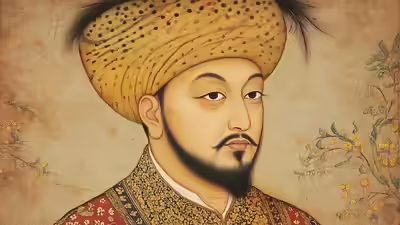
Baiju Noyan was one of the fiercest and most influential Mongol commanders of the 13th century. He governed and led military campaigns across vast regions including modern-day Iran, Baluchistan, Afghanistan, Azerbaijan, Armenia, Anatolia, and Georgia. His leadership played a decisive role in the Mongol Empire’s expansion into the Middle East and the Caucasus.

Baiju was appointed by Ögedei Khan, the third son of Genghis Khan, to succeed Chormagan, one of the most renowned generals of the Mongol Empire. This appointment placed Baiju in charge of critical western territories, where he continued the Mongol tradition of disciplined warfare and strategic dominance.

Baiju Noyan is particularly known for leading Mongol forces deep into modern-day Turkey, Armenia, and Georgia. His campaigns often brought him into conflict with powerful regional states. One of his most significant military achievements was his victory over the Seljuk Sultanate of Rum.
The Battle of Köse Dağ (1243)
In 1243, Baiju commanded Mongol forces at the Battle of Köse Dağ, where he decisively defeated the Seljuk army. This victory shattered Seljuk resistance and established Mongol dominance over Anatolia. Following this battle, the Seljuk Sultanate became a vassal state, marking a turning point in the political history of the region.

Baiju’s campaigns significantly contributed to the Mongol Empire’s control over western Asia. His ability to combine speed, coordination, and psychological warfare made him one of the most effective Mongol commanders of his era.
Despite his historical importance, much of Baiju Noyan’s personal life remains shrouded in mystery. What is known comes primarily from Persian, Armenian, and Islamic chronicles, which portray him as a formidable and relentless military leader.
Today, Baiju Noyan stands as a key figure in the Mongol conquests of the 13th century, remembered for shaping the political landscape of Persia, the Caucasus, and Anatolia through decisive and far-reaching military campaigns.