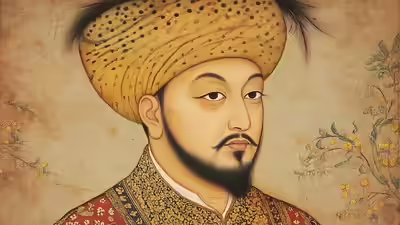
Babur, , the founder of the Mughal Empire, is often remembered for establishing a powerful dynasty in the Indian subcontinent. However, a closer reading of contemporary sources — including Babur’s own autobiography, the Baburnama — reveals a far harsher reality behind his rise to power.
Babur was a product of Central Asian steppe warfare traditions, where conquest was inseparable from intimidation, mass punishment, and public displays of violence. These practices were not unique to Babur, but he documented them with unusual frankness.
Violence Recorded in Babur’s Own Chronicle
Unlike many rulers whose brutality is known only through hostile accounts, Babur openly described acts of extreme violence in his own writings. In multiple campaigns across Central Asia, Afghanistan, and northern India, he recorded the construction of towers made from the severed heads of defeated enemies.
Such head towers were intended as psychological warfare — a warning to cities considering resistance. Babur described these actions not with regret, but as accepted instruments of military policy.
Massacres as a Tool of Control
Babur’s campaigns frequently involved mass killings following resistance. In regions that opposed him, entire populations were subjected to slaughter, enslavement, or forced displacement. These actions were consistent with Timurid and Mongol military traditions, where terror was used to ensure rapid submission of future targets.
After victories, Babur often permitted the plunder of cities, resulting in widespread civilian suffering. These were not accidental excesses but expected outcomes of conquest.
The Invasion of Northern India
During Babur’s invasion of northern India in the early 16th century, his armies employed gunpowder weapons alongside traditional cavalry tactics. While the Battle of Panipat (1526) is often highlighted for its military innovation, the aftermath saw extensive destruction and killing.
Contemporary records indicate that resistance was met with severe reprisals, reinforcing Babur’s reputation as a conqueror who ruled through fear as much as force.
Religious Justifications and Warfare
At times, Babur framed his campaigns using religious language, describing certain conflicts as struggles against unbelievers. While political ambition was the primary driver, religious justification was used to legitimize violence and rally troops.
This blending of faith and warfare intensified the brutality of some campaigns, as opponents were portrayed not merely as political rivals, but as existential enemies.
Context Does Not Mean Excuse
Historians emphasize that Babur’s actions must be understood within the norms of 15th–16th century conquest, where extreme violence was widespread. However, acknowledging historical context does not diminish the suffering inflicted on civilian populations.
What makes Babur distinctive is not only the scale of violence, but the clarity with which he recorded it — leaving little doubt about the methods used to establish Mughal rule.
A Complex Legacy
Babur was also a poet, a keen observer of nature, and a cultured ruler. Yet these qualities coexist with a documented record of severe brutality. The Mughal Empire that followed would evolve into a more structured state, but its foundation was laid through conquest marked by bloodshed.
Understanding Babur in full requires confronting both aspects of his life — the cultured chronicler and the ruthless conqueror — without romanticizing or erasing either.