:contentReference[oaicite:1]{index=1}, commonly known as the Grand Mufti of Jerusalem, was a Palestinian Arab nationalist and influential Muslim religious leader during the period of British Mandatory Palestine. He belonged to the prominent al-Husayni family of Jerusalem, which traced its lineage to the Islamic Prophet Muhammad.
Al-Husseini emerged as a central political and religious figure in Arab opposition to Zionism and British rule in Palestine. During the Second World War, his political activities and alliances extended beyond the Middle East, eventually drawing him into collaboration with Nazi Germany.
Israeli historians and post-war investigations have attributed to al-Husseini an ideological and propagandistic role connected to the Holocaust in Europe, particularly through his cooperation with the Nazi regime and his encouragement of anti-Jewish policies.
The Meeting with Hitler
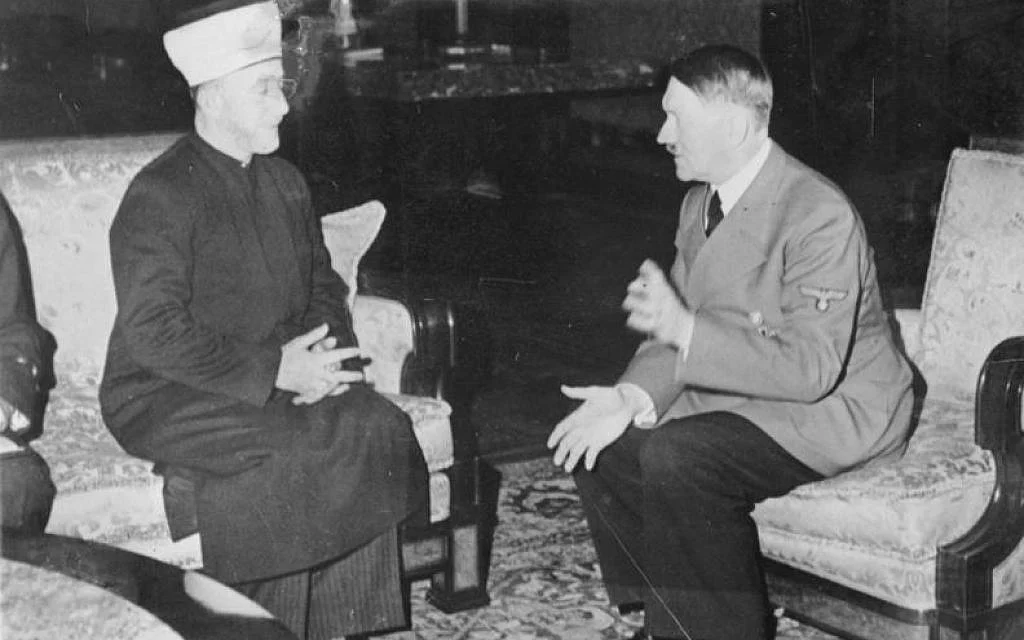
In November 1941, al-Husseini met with :contentReference[oaicite:2]{index=2} at the Reich Chancellery in Berlin. During this meeting, al-Husseini sought explicit German assurances that the Nazi regime would oppose the establishment of a Jewish homeland in Palestine and support Arab independence.
Hitler declined to issue a public declaration or formal treaty at that time. However, he emphasized that Germany’s broader war objectives included the destruction of what he referred to as the “Jewish-Communist European empire.” He further stated that once German forces approached the Middle East, Germany would issue assurances to the Arab world that the moment of liberation had arrived.
Hitler made clear that the Nazi regime viewed opposition to a Jewish homeland in Palestine as part of its wider anti-Jewish struggle. He asserted that Germany’s immediate goal was the annihilation of Jewish populations living under British influence in the Arab world.
Role During the War
Al-Husseini’s responsibilities, as outlined by Hitler, were largely political and ideological. He was expected to mobilize Arab resistance and anti-Jewish sentiment once conditions permitted. In addition, al-Husseini participated in Nazi propaganda efforts, including radio broadcasts aimed at the Arab world that promoted anti-British and antisemitic views.
He also supported the recruitment of Muslim units for the Waffen-SS in the Balkans, further aligning himself with the Nazi war effort. While historians continue to debate the extent of his direct influence on Holocaust policy, his collaboration with Nazi Germany placed him firmly within the ideological framework that supported genocide.
Historical Assessment
The legacy of Amin al-Husseini remains deeply controversial. While he did not design or administer the Holocaust, his alliance with Nazi Germany and his advocacy against Jewish survival and statehood have led many scholars to associate him morally and politically with the genocidal aims of the Nazi regime.
His actions illustrate how ideological alliances during the Second World War transcended geography and religion, linking European antisemitism with political movements in the Middle East during one of history’s darkest periods.